Main concepts
Objects
In Sen, the communication is modeled around the idea of objects interacting with each other. In a nutshell,
-
Objects can contain data and code. The data is in the form of properties, and the code is in the form of methods.
-
Methods are functions that can be called by other components. Methods can have arguments and may optionally return a value.
-
Objects can emit events. Other components can react to those events. Events can have arguments.
-
Objects are instances of classes, and a class may extend one other class. Unlike C++, a class cannot extend two: the type language rejects that with "Cannot inherit from more than one class. Consider using interfaces." The interfaces it means are the ones the code generator writes for you: every class gets a
<Name>Interface, which both the local implementation and the remote proxy inherit. Hold a reference to that and your code does not depend on whether the object it is talking to lives in your process or on another machine.


You can discover objects published by other components, examine their properties, call their methods and react to their events. You can also publish your own objects, so that other components can "see" you, call you, and react to your changes.
Objects are identified by name, so names have to be unique. You are responsible for naming your objects. Once named, objects also provide a (32-bit) numeric identifier that is more "computer-friendly".
Methods can be optionally marked const. This means that they do not change the internal state of
the object.
Properties can be:
-
Static: You have to set a value when constructing the object. Once set, this property will not change. Think of the word "static" simply as not being "dynamic". The equivalent in C++ or Java would be a constant member variable that must always have a value. Note that this value can be different for every instance.
-
Dynamic: You may set a value when constructing the object, but the important trait here is that this is a property that may change at some point. Other components may react to those changes.
-
Read Only: You, the one implementing the object, decide when to change the property value. Other components cannot directly change it. The only way they might end up triggering a change is if they call some of your methods, and you end up deciding to do the change.
-
Read Write: Other components might call the setter method and change its value (without your permission or awareness). If you need a say, mark the property as checked; see Object Ownership further down this page.
By default, properties are dynamic and read-only.
Methods, properties and events can have a quality-of-service attribute that can be:
-
Confirmed. The call, response or notification is guaranteed to arrive. The order of emission and reception is maintained. For in-process interactions this is implemented as (potentially queued) function calls. TCP is used for inter-process communication.
-
Best Effort. The call, response or notification will be sent as fast as possible. There are no guarantees regarding reception or ordering. Old data does not overwrite newer data. This is typically used when you are interested in the latest data, low latency and are OK with sporadic missing packets. For in-process communication, this is implemented using (potentially queued) function calls. UDP unicast is used for inter-process method calls. UDP multicast is used for inter-process events.


Sen's guarantees line up with those of TCP and UDP. In controlled environments, a single computer, a local area network with bounded traffic, or basically anything that is not the internet, you are very likely fine with best effort: packet loss there is a sign of an infrastructure or load problem rather than normal operation.
The choice is yours except in one case. A dynamic property whose type is unbounded
has to be [confirmed], because best effort could leave you with incomplete, incorrect or
inconsistent data. Leaving the attribute off does not work either: properties default to best
effort, so an unbounded one is rejected until you ask for [confirmed] in as many words. Static
properties are exempt, as they never travel as updates.
Methods are typically expected to execute when called, but this may create contention if there's a significant amount of callers, as they would queue up. In Sen, you can mark methods so that they can provide deferred answers. This allows them to ingest multiple calls without having to provide an answer straight away. This allows for techniques like batching of responses, delegating those calls to other elements (i.e. load balancing) or the parallelization of work.
Object Ownership.
In Sen, objects are strongly owned by the component that creates them. If the owning component goes away (is halted, shut-down, crashes or gets disconnected), all its objects will be automatically removed.
That removal is all Sen does. Subscribers see the objects go, and nothing tells them why: a crash and a deliberate deletion look the same, both live and in a recording, where a deletion carries only the object's identity. There is no watchdog, no restart and no health policing anywhere in the kernel.
That is deliberate, and not an omission. Whether a dead component should be restarted, whether the run continues, and who gets told are decisions about the exercise and not about the objects, so they belong to whatever supervises it. Sen is a reasonable substrate for building that orchestrator, and stays out of the decision itself.
When it comes back, you do nothing. The returning kernel is discovered again on its own, and the interest you already hold serves its objects without being re-issued: you see the removal once, then a fresh arrival. That arrival carries state. The receiving side asks for the state of the objects it has just accepted and the publisher serves it, so an object is populated when it appears rather than filling in as later updates happen to land.
The object that comes back is a new object. Sen promises no re-identification, so matching it to the one that went away, by name or by anything else, is yours to do. A component that restarted and a network that healed look the same from here, because the remote side is torn down and discarded either way, and nothing you can see distinguishes them.
Ownership governs lifetime, not every write. An object is responsible for its own properties, but a
Read Write property really is written from outside: the caller's setter puts the value into
the object's next buffer, and the owner finds out afterwards through
on<Prop>Changed(), if it subscribes at all.
If the owner needs a say, mark the property as checked in codegen_settings.json. The generator
then adds a virtual bool hook the owner overrides, and the setter calls it before storing
anything. Returning false rejects the write: the value is not applied, and the caller is told.
Because a setter is dispatched like any other method, the rejection reaches them as a failed result
rather than escaping into your component. See Customizing the generated
code and the checked properties
example.
Asynchronous behavior.
Sen is a fully asynchronous system. This means that when calling a method you should not expect it to execute immediately after the call is made. It will not block. Sen will trigger the execution at a future time and will call you back if you provide a callback function. If the method returns a value, the callback will receive it, and you will be able to use it. If the method threw an exception, you will be able to examine it and re-throw it if needed.
Objects are only half of it. What can you use as an argument for a method, or as a property?
Types
The Sen type system is rich:
- Signed and unsigned integers (
u8,i16,u16,i32,u32,i64,u64). - Floating point values of 32 and 64 bits (
f32andf64). - Basics: Boolean (
bool) and String (string). - Time: Time stamps (
TimeStamp) and time durations (Duration). - Enumerations (with an integral storage
T,enum : T {...}). - Structures (with 0:n fields of any value type,
struct {...}). Single inheritance is supported. - Variants (holding 1:n distinct types,
variant { T1, ... Tn}). - Sequences (of any value type, bounded, unbounded, and fixed
sequence<T>,sequence<T, n>,array<T, n>). - Quantities (of any numeric type, with a given unit and an optional min and max value).
- Optionals (of any type).
- Classes and interfaces.
A variant holds exactly one of its listed types at a time, and it knows which one it is holding. The
value lives inside the variant itself, in space sized for the largest alternative, so assigning to a
variant never allocates. Each type may appear only once in the list: variant { i32, i32 } is
rejected at generation time with variant contains type 'i32' more than once, since there would be
no way to say which of the two you meant.
Sen will auto-generate the code to natively support these types in your language. The only type that you have to "worry" about is the "class", as you will need to inherit from a generated base class in order to implement your logic.
In Sen, you can define your types using a very small language called Sen Type Language (STL, more on this later). For those interested in simulation, you can also use HLA FOM.
Components


A component holds:
- An interface, used to interact with other components.
- The functional logic (the code) that is in charge of the actions. This logic often holds state.
- An execution context, that allows the functional code to run. In Sen, this is a thread.
Components are self-standing. This means you can always instantiate them, and they will run. When components need to talk to each other, they will declare it and Sen will provide them visibility.
A system needs a context to run in and a way for components to talk to each other. In Sen, the inter-connection mechanism for components is called a kernel.


Components are also relocatable. This means that they can be moved to other execution contexts (processes or threads) without having to change a single line of code.


When components are separated by process boundaries, Sen will take care of transparently handling the inter-process-communication (IPC) while respecting their quality-of-service requirements.
Moving components


In Sen, you are free to run your components in the same or different thread, process or computer. This gives you a great degree of flexibility to adapt. Just keep in mind that:
-
When components are far away, more resources are required to make them run and interact. There are also fewer chances for interference.
-
When components are close to each other, the interaction is cheaper, but the chances for interference are higher.
The underlying reason is resource sharing.
For example, let's say that you decide to put all your components in a single process. The effort to move the data between them will be low, but if one component crashes or corrupts the memory it could bring all your system down. Let's now say you go the other way and decide to have each component in an independent process. In this case, a crash of a component will not bring the others down, but you will be asking the operating system to allocate more resources, create and schedule more processes, copy more data between them and do more synchronization work.
You have to decide how and where to group your components based on the trade-offs you are willing to accept and the needs of your project/environment. Sometimes, what matters is the convenience of having everything in one process. Sometimes, what matters will be the performance gain of grouping components that exchange huge amounts of data. Maybe, during development you will want to keep some components running, while starting and stopping the one you are currently working on. You are in control and can set the grouping that best fits your needs.
With Sen, these groupings are nothing more than entries in configuration files, and the good thing is that you can have as many as you want and use them when and where you need.
There is another axis to consider: moving components to processes in other computers.
This is also possible, and your code does not change: the same calls, the same subscriptions, the same objects. What distance changes is timing and failure. In this case you need to consider the following:
-
Calls and updates take longer, and by an amount that varies. A method result that comes back within a cycle or two locally can take several cycles across a loaded network, so code written against a prompt answer needs a timeout and something useful to do while it waits.
-
Best-effort properties and events can be dropped. Nothing is lost this way inside one process. Declare a property or an event as
confirmedwhere missing an update is not acceptable. -
You are gaining in isolation and robustness. If a machine halts or the OS becomes overloaded, the components on other machines keep running. They do lose the objects the halted machine owned, so a component that was tracking them has to cope.
-
You are gaining in computing power. You have more resources and can do more. Make sure you are using those resources effectively and locating components accordingly.
-
You need a network between those computers. You will be imposing more on the infrastructure. Having a network card is a non-issue these days, but do not underestimate the effort of properly setting-up, configuring and maintaining a clean network layout. Remember also that switches and routers might be in the loop and those also need to be configured and maintained (i.e. IGMP Snooping, V-LANs, etc.).
-
You will need a way to deploy your binaries, start/stop your processes and monitor their execution. Maybe you will also need to debug them when they crash or do performance profiling in a particular configuration.
-
Testing will become more complicated. You now have more moving parts and the network is, by nature, a shared resource. This means that if you don't have an isolated network, running your tests in parallel will cause them to interfere with each other and fail.
Now, the issues listed above are not unique to Sen, but common to any distributed system. Thankfully, there are mature solutions that help you overcome many of these challenges during development, testing and production: containers and orchestrators.
Containers allow you to create self-contained, deployable units of software that can be executed in isolation and with a great degree of options, tools and features. They allow for things like hosting versioned containers in repositories, layering, etc. If you are not familiar with containers, you can think of them as extremely lightweight virtual machines that have no runtime performance overhead. Tools like Docker Compose allow you to mimic distributed systems by isolating the execution of multiple containers that communicate to each other over virtual networks and for which you can allocate certain computer resources.
Container Orchestration Platforms, like Kubernetes, go beyond and allow the deployment, execution management and monitoring of containers at scale over heterogeneous computing clusters.
Grouping components
Components might depend on each other and some require to be initialized and started before others. Groups are basically a mechanism to define that order and ensure consistency. This is not a new concept (and in fact is widely used in similar systems, specially OS microkernels). In this case it is fully defined by the environment, and it works as follows:
- Components always have an associated group.
- During start-up, the kernel increases the group until it reaches the highest.
- To increase to a given group, all components associated with it must have been correctly initialized and their execution started.
- During shut-down, the kernel decreases the group until it reaches the minimum.
- To reduce to a given group, all components associated with it must have been correctly stopped and their execution halted.
In the (somewhat unlikely) case that you are writing a component that would need to perform some
action during the initialization, loading or unloading, you are free to implement (override) the
corresponding init(), load() and unload() functions.
There is one hook that sits outside the group progression: preload() runs for every component
before any of them is loaded, whatever their group. That makes it the place for something the whole
process needs before anything else starts. The tracy component uses it to install a profiler
before the rest of the system exists, and unload() to shut it down again.
Say you have components A, B and C, with A and B in group 1 and C in group 2. The initialization logic then progresses as follows:
- The kernel starts at group 0, and it advances to group 1.
- In group 1, the kernel finds the A and B components, so it: (1) loads them, (2) initializes them, and gets them running. It has now reached group 1.
- In group 2, the kernel finds C, so it (1) loads it, (2) initializes it and (3) runs it.
- The kernel does not find any other group, so it reaches the "running" state.
At this point, if you command the kernel to shut down, the kernel does the same process, but in reverse.
- In group 2, the kernel finds C, so it stops it and then unloads it.
- In group 1, the kernel finds the B and A components, so it stops them, and then unloads them.
- The kernel does not find any other group, so it reaches the "stopped" state, and finishes the execution.
You see that during start-up the kernel proceeds by groups, and within each group it goes by layers: loads all of them, initializes all of them and runs all of them. During shut-down, it does the reverse, but it stops all components, and then unloads them.
Buses
So far, we have said that components provide functionality within a system, run in an execution context and can interact with each other using a well-defined interface over a communication channel. Let's now dive a bit deeper and see how the communication takes place.
- Components are created and connected to each other over the kernel.
- There's one kernel per process (normally).
- There can be many components, even across processes and computers.
- In the kernel, components can find (and create) sessions. Sessions act like namespaces that allow the segregation of information per system. Sessions are identified by name.
- Within a session, components will find (and can create) buses. Buses also act as namespaces to segregate the communication, but with a finer degree of detail.
- Inside a bus, components can find (and publish) objects. Being a distributed object-oriented system, objects are the basic element in Sen.
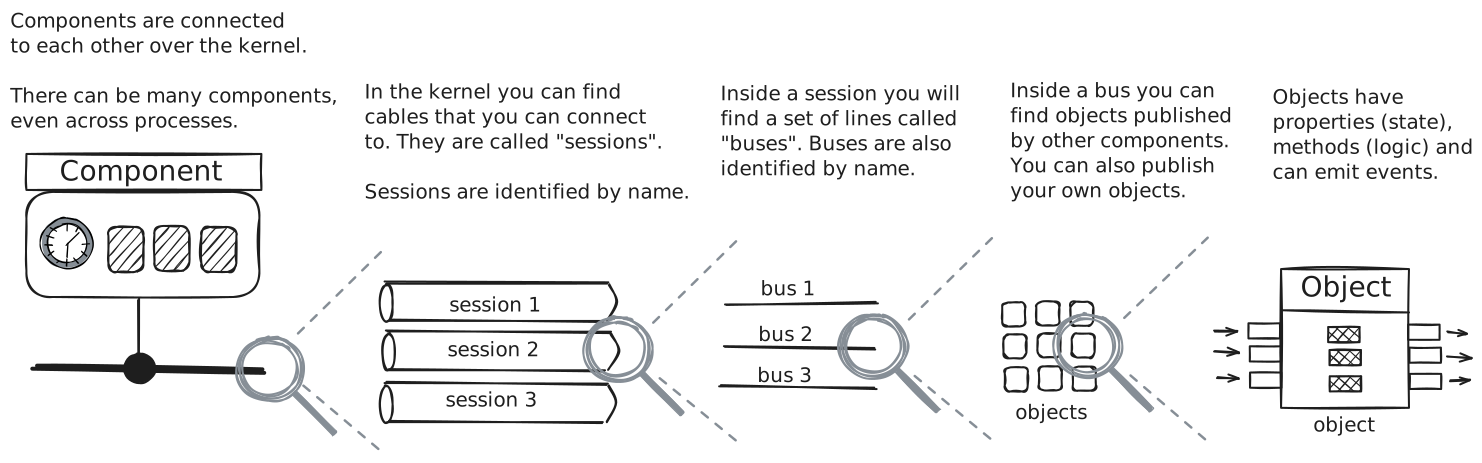

This creates a system where a bus is addressed as <session>.<bus>, and an object within it adds
its own name: <session>.<bus>.<object>.
For example, a building monitoring system may use a session named "monitoring", and then have a bus
for each building. The buses could be named like "monitoring.headquarters",
"monitoring.offices", "monitoring.depot", etc. If there would be another system, it could use a
different session name and define its own buses.
What the partitioning actually costs and buys
Sessions and buses are not only names. When components are distributed, the ethernet transport turns them into real network structure, and that has consequences for how many of each to have.
Each bus a participant joins gets its own multicast group and its own socket, and the group address is derived from the session name, the bus, and the discovery port together. That has consequences:
- Traffic is separated below your process. A host that has not joined a bus does not receive its multicast traffic at all. The operating system filters it, so it costs nothing to ignore. This is the difference between partitioning with buses and filtering with interests: interests decide what you are told about, buses decide what reaches your machine in the first place.
- A different session is a different system. The session name is part of the group address, and
participants also ignore remote kernels whose session differs, so no connection is opened and no
object traffic crosses between them. They do still discover each other's presence: a kernel from
another session shows up in the list of available sessions, which is what makes
openpossible in the term.
The cost is the other side of the same fact: a socket and a group membership per bus actually in use. Splitting a system across many fine-grained buses is not free, and a handful of well-chosen buses will usually serve better than one per object. Note the resources follow use, not declaration: a bus nobody joins costs nothing.
You are free to name your sessions and buses as you like, and follow your own criteria for categorizing your object groupings. This is something that you need to evaluate based on the nature of the problem that you are trying to solve, and the convenience that you might get from this feature. The key take-away here is that you are able to segregate the communication between your systems and within your system by using sessions and buses.
Packages
Normally, a component would:
- Detect objects published by other components (and interact with them), or
- Publish your own objects, or
- Do both
Sen needs to know the types of the objects to be able to help you with this. Here is where packages help.
Packages streamline the handling of types in all situations. Think of a package as a catalog of types that can be used by Sen when working with components. Some of those types are interface definitions (classes), but packages can also contain your implementation of some classes. This means that packages can hold general types and your functional logic.
For example, let's say that you have an interface definition with the classes w, x, y and z. You don't know much about w and x, but want to implement y and z. You write your implementation for those two classes and create a package out of that.
Now you have a package containing the binaries of your implementation. It also contains the definition of all the types you work with and meta information that encapsulates all these facts.
A package is a factory for objects. Users of your package can instantiate objects of class y and z. They won't know the details of your implementation, but they know the interfaces and can create objects of those types.
If the same can be achieved with a header file and a static or shared library, what does this mechanism add? In fact, packages are libraries. Specifically, packages are shared libraries that can be natively loaded by a Sen kernel. The particularity of packages is that they are created with a uniform interface that allows Sen to inspect all the meta information it needs to understand what is being provided.
This means that Sen is able to instantiate objects (depending on the packages that you may want to import) and use configuration parameters. This creates a huge opportunity for getting rid of boilerplate code.
Most Sen applications share a pattern. Normally you:
- Instantiate the components and get them to run.
- Load some sort of configuration information / parametrization data.
- Load a set of packages holding classes that can be instantiated.
- Instantiate a set of classes (create your own objects).
- Establish a connection between the component and to some set of buses.
- Publish your objects to those buses.
- Enter an execution loop where you:
- Drain the inputs from the outside (discovered objects, received method calls, received events or received property changes).
- Update: perform some computation based on those inputs, and produce some outputs (published objects, outgoing method calls, emitted events or property changes of the owned objects).
- Commit those outputs so that other components can react to them.


If we don't do something about it, every Sen user will likely do the previous steps in slightly different ways, using different approaches, getting the configuration data from different sources in different formats and therefore ending up re-doing the same work many (many) times across an undefined set of projects and with a wide range of bugs.
Sen identifies those common needs and ships a reference implementation, so you can instantiate components that do all of this in a structured way.
In most cases, there are only a few things that vary between applications:
- The packages you need to import to instantiate your objects.
- The objects you want to instantiate and their initialization values.
- The buses where you want to publish your objects and discover the ones published by other components.
- The criteria you use to discover other objects.
Sen lets you define all of this in a configuration file, so your code is left with the logic.


Keep in mind that the configuration file can contain the information for instantiating multiple components in your process.
Being able to build and instantiate custom components based on a set of packages and a configuration file is key for enabling a powerful degree of composition.
Packages become common assets. Sen's multidimensional modularity lets you:
- define a rich interface for your objects, using the type system
- group your implementation into reusable, deployable modules, using packages
- group objects to perform a well-defined function within a system, using components
- define and parametrize components with configuration files
- instantiate multiple components in a process, telling Sen which ones to load and run in a configuration file
- change where those components run, transparently to your code, even when they communicate over a network, at the cost distance brings
- do all of the above in a type-safe manner, without dealing with low-level messaging constructs
Your focus stays on the logic you implement and the information you use, not on how or where it arrives.
Things to remember
- Components are the units of execution in Sen.
- Packages are libraries of classes that can be loaded by the kernel.
- Packages contain your implementation for some classes.
- The Sen kernel is able to build custom components by importing packages and instantiating objects. This is done via configuration files. This is also the easiest and most flexible way of creating components.
- You can also implement your own components, with code.
See Also
- Create your first package: put these concepts into practice
- Execution model: a deeper look at the drain-update-commit cycle
- STL language reference: how to define types for your objects
- The configuration file: the full YAML reference
- How-to: Working with objects: registration, subscriptions, events in C++